Lattices
We work on regular hypercubic lattices in \(D\) dimensions with \(N\) sites per direction and periodic boundary conditions.
Note
The lattice is specified by a single \(N\): every direction has the same number of sites.
This equal-size (hypercubic) assumption is baked into much of the code — modular arithmetic
on coordinates, the Fourier-transform and correlation helpers, and observables that normalize
by a length or volume (for example VortexSusceptibilityScaled, which scales by
\(N^{D}\)). Anisotropic lattices with a different number of sites in different directions are
not supported.
The Interlaced Picture
Fields do not only live on sites. A scalar field assigns a value to every site, but a gauge field assigns a value to every link, a field strength to every plaquette, and so on: a \(p\)-form (see Differential Forms) assigns a value to every \(p\)-dimensional cell of the lattice.
Every cell has a natural geometric location. A site sits at integer coordinates \(n = (n_0, \ldots, n_{D-1})\). The link leaving \(n\) in direction \(k\) is centered half a step away, at \(n + \hat{e}_k/2\). The plaquette anchored at \(n\) spanning directions \(j\) and \(k\) is centered at \(n + (\hat{e}_j + \hat{e}_k)/2\). In general, the \(p\)-cell anchored at \(n\) spanning the directions \(I = (i_1 < i_2 < \cdots < i_p)\) is centered at \(n + \frac{1}{2} \sum_{i \in I} \hat{e}_i\).
Doubling every coordinate clears the half-integers. Measured in half-lattice units, the cell anchored at \(n\) spanning the directions \(I\) sits at
where \(\mathbb{1}_I\) has a 1 in the directions the cell spans and a 0 elsewhere. Now every cell of every degree occupies a distinct integer point of a \((2N)^D\) lattice, and the parity of the coordinates says what kind of cell lives there: \(x_k\) is odd exactly when the cell extends in direction \(k\). A \(p\)-cell is a point with exactly \(p\) odd coordinates, and its anchoring site is always \(n = \lfloor x/2 \rfloor\).
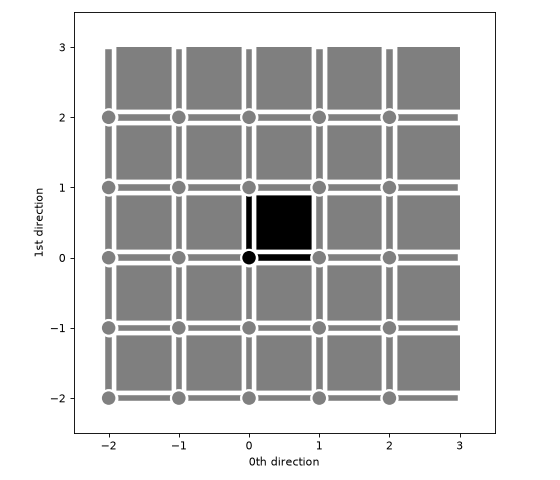
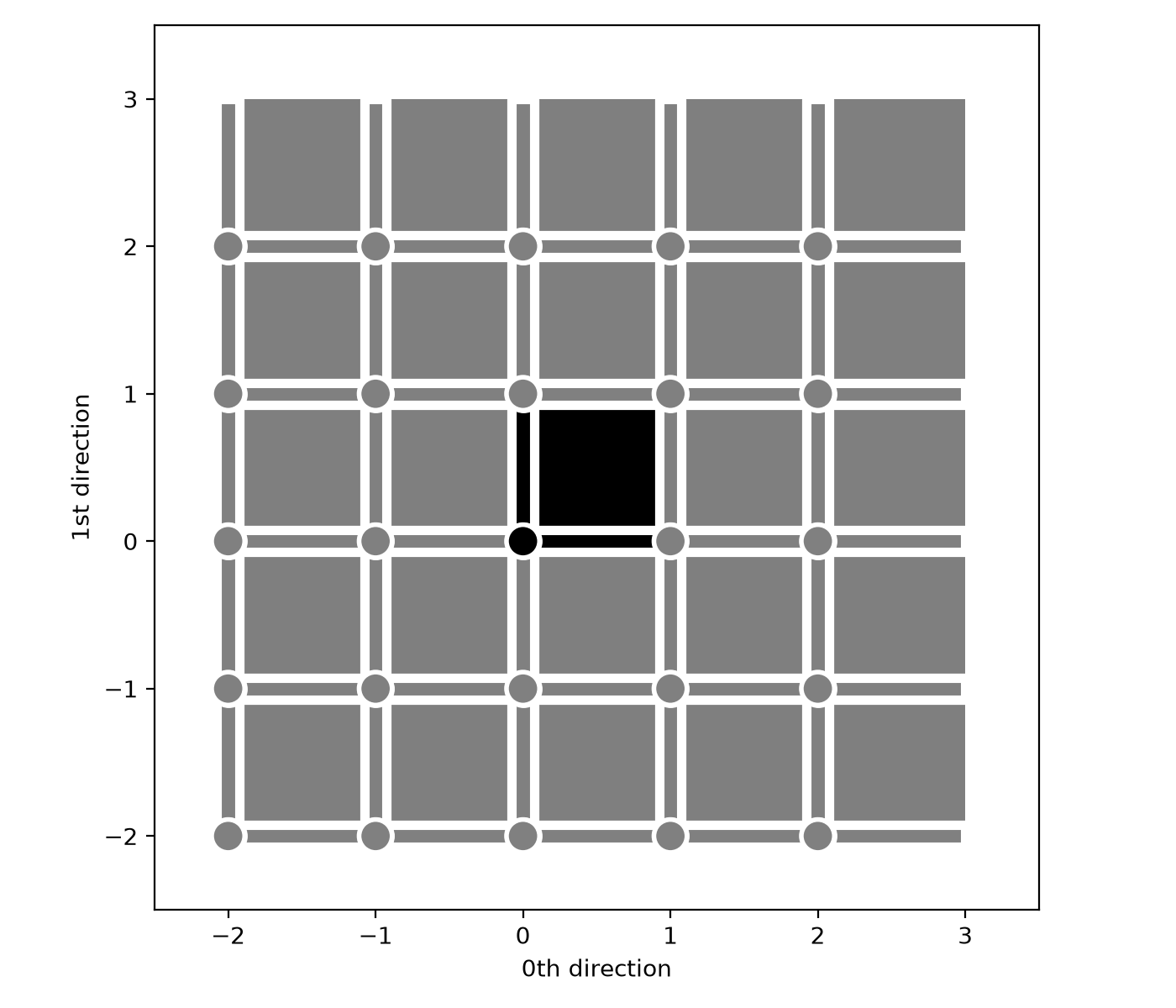
We call this doubled lattice interlaced because the cells of every degree are interleaved on a single grid. The figure below shows the four cells anchored at the origin of a two-dimensional lattice: the site at interlaced coordinates \((0,0)\), the two links at \((1,0)\) and \((0,1)\), and the plaquette at \((1,1)\).
(Source code, png, hires.png, pdf)
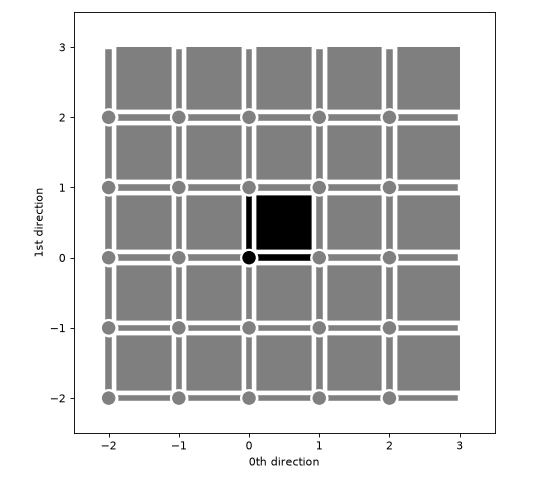
The interlaced picture is how the code “thinks” geometrically: which cells are incident to which, which neighbor a value is gathered from, and where the operators of the exterior calculus get their shifts and signs. The storage, however, is compact: a point with exactly \(p\) odd coordinates is rare (only \(\binom{D}{p}/2^D\) of the doubled lattice), so a \(p\)-form is stored as an array of shape \((\binom{D}{p}, N, \ldots, N)\) whose 0th axis enumerates the components — the sorted direction tuples \(I\), in lexicographic order — and whose remaining axes give the anchoring site \(n\). See Form.
A reference implementation that stores forms directly as sparse \((2N)^D\) interlaced arrays is documented with the other reference implementations. But even on small 4-dimensional lattices the interlaced representation is much slower than the compact representation, so we use the compact representation for all practical purposes.
Arbitrary Dimensions
We provide common machinery for working with (hyper)cubic lattices in arbitrary dimensions.
For some purposes (like plotting) it is useful to have a specialization; for example below we provide Lattice2D for two dimensions.
- class supervillain.lattice.Lattice(D, N)[source]
A D-dimensional hypercubic lattice with N sites per direction.
The lattice knows how to enumerate the components of any p-form and can create zero or random p-forms on demand.
- classmethod from_h5(group, strict=True, _top=True)[source]
Reconstruct from HDF5 by reading D and N reconstructing the rest.
- property sites
Total number of sites \(N^D\).
- property dims
Tuple of side lengths (N, N, …, N), length D.
- property origin
The origin site \((0, \ldots, 0)\), a tuple of length \(D\). Use it to index the zero-displacement element of a scalar field or correlator of shape \((N,)^D\) (e.g.
correlator[lattice.origin]) without assuming \(D=2\). AFormhas a leading component axis, so index the component first:form[c][lattice.origin].
- property dim
Number of dimensions (alias for D).
- property links
Total number of links (1-form components) \(D N^D\).
- property cells_of_degree
p → number of p-cells = \(C(D,p) N^D\).
- Type
dict[int, int]
- property cells_of_codegree
q → number of (D−q)-cells = \(C(D, D−q) N^D\).
- Type
dict[int, int]
- property coords
FFT-convention coordinate for each lattice site, shape (D, N, …, N).
- property checkerboarding
Partition lattice sites into colors with no same-color nearest neighbors.
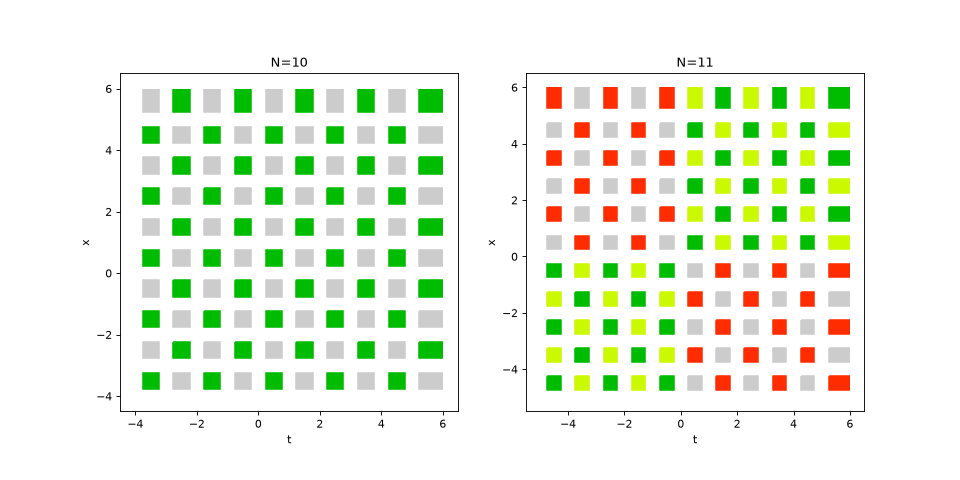
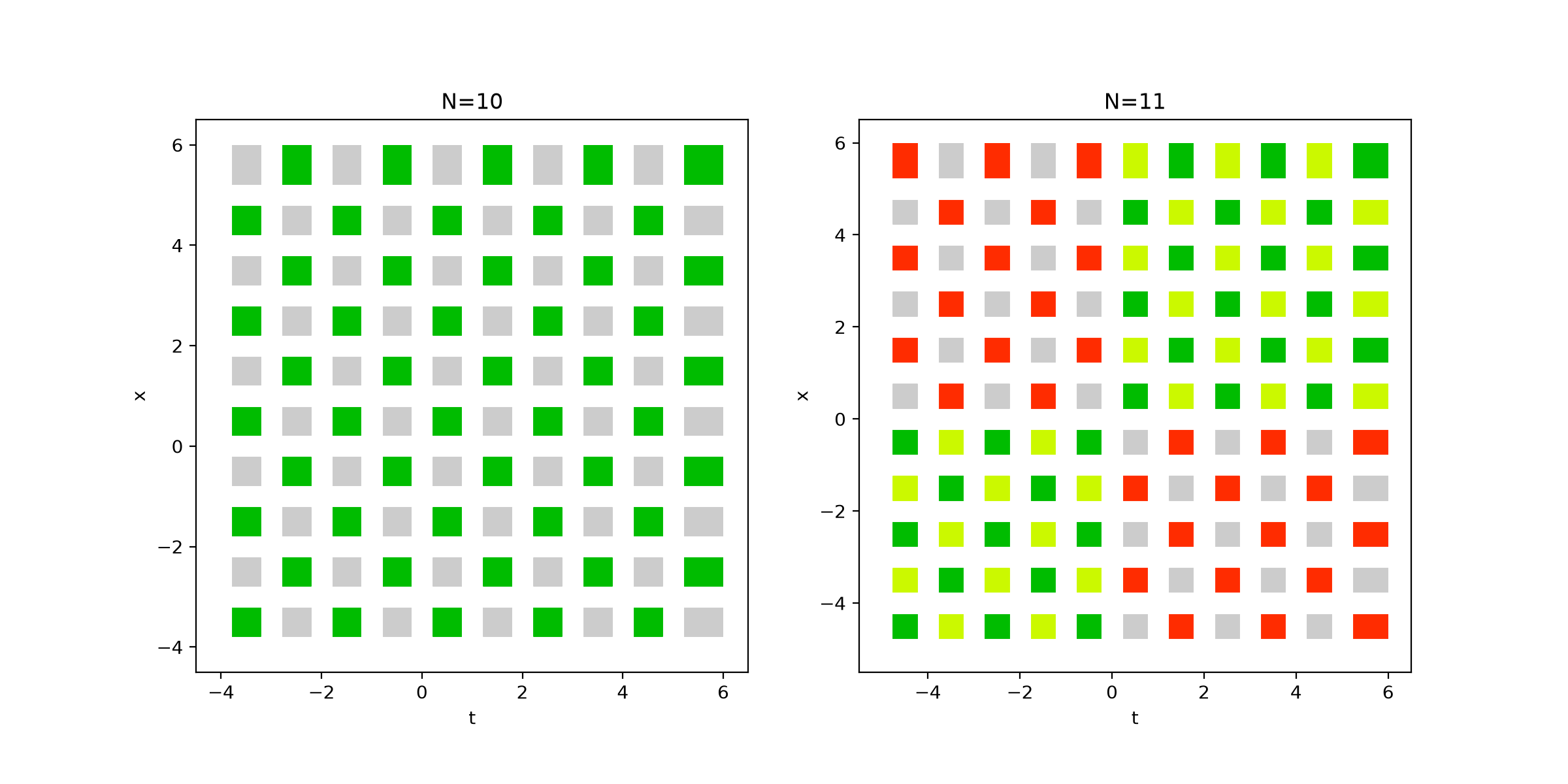
On a lattice of even size both the sites and plaquettes can be bipartitioned so that no simplex of one color has a neighbor of the same color. On an odd-sized lattice the periodic boundary conditions make it impossible to accomplish this with only 2 colors, but a similar construction with more colors is possible.
With even \(N\) there are two colors (coordinate-sum parity); with odd \(N\) there are \(2^{\max(D, 2)}\) to ensure that no nearest-neighbor sites share a color. The figure below shows both cases for D=2:
(
Source code,png,hires.png,pdf)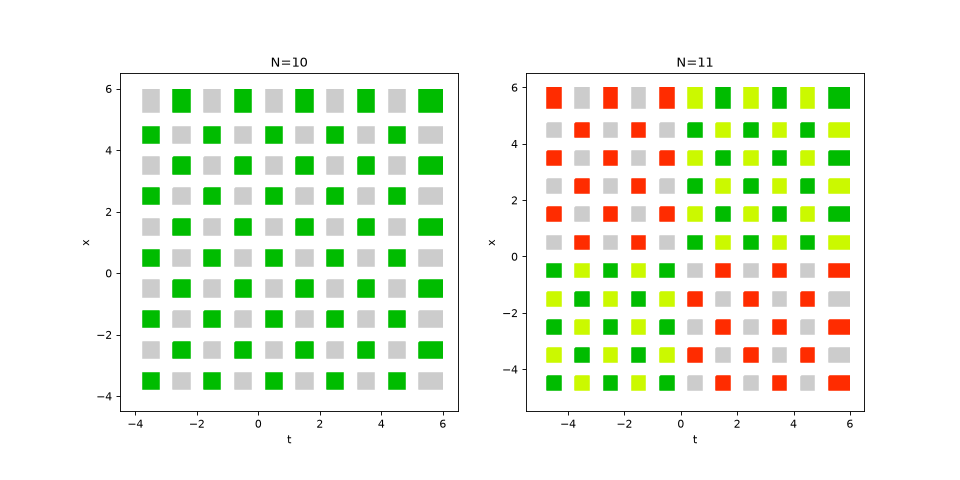
- Returns
tuple of index-array tuples – One
np.whereresult per color; each element selects that color’s sites from the D spatial axes of a form:for i, color in enumerate(L.checkerboarding): form[(slice(None), *color)] = i
.. warning:: – No promise is made about the future sizes of the color partitions. For example, it might be wiser for performance to split the odd-N colors less evenly. All that is promised is that within each color no site shares a nearest-neighbor edge with a site of the same color.
- zeros(p, dtype=<class 'float'>)[source]
Return a zero p-form.
- Parameters
p (int) – Form degree.
dtype (data-type, optional) – np dtype for the underlying array (default
float).
- Returns
Zero p-form of shape
(C(D,p), N,...,N).- Return type
- random(p)[source]
Return a p-form with entries drawn uniformly from [0, 1).
- Parameters
p (int) – Form degree.
- Returns
Random p-form of shape
(C(D,p), N,...,N).- Return type
- form(p, dtype=<class 'float'>)[source]
Return a zero p-form.
Alias for
zeros().- Parameters
p (int) – Form degree.
dtype (data-type, optional) – NumPy dtype (default
float).
- Returns
Zero p-form of shape
(C(D,p), N,...,N).- Return type
- property R_squared
Distance-squared from the origin at each site, shape (N,…,N).
- distance_squared(a, b)[source]
Squared lattice distance between coordinate vectors
aandb.Accounts for periodic boundary conditions: the distance is computed via
mod(a - b), so it is the shortest-path distance on the torus.- Parameters
a, b (array_like) – Coordinate vectors of shape
(D,)for a single pair, or(..., D)for a batch.- Returns
Scalar for a single pair, shape
(...)for a batch.- Return type
np.ndarray
- property coordinates
Array of shape (sites, D) listing every site’s coordinates.
- mod(x)[source]
Map integer coordinates into FFT-convention lattice values.
- Parameters
x (array_like) – Integer site coordinates (any shape).
- Returns
Coordinates in the range
[-(N//2), N//2)(FFT convention).- Return type
np.ndarray
- fft(form, axes=None)[source]
D-dimensional DFT over the spatial axes of
form.\[F_{\boldsymbol{k}} = \frac{1}{N^{D/2}} \sum_{\boldsymbol{x}} e^{-2\pi i \boldsymbol{k}\cdot\boldsymbol{x}/N} f_{\boldsymbol{x}}\]- Parameters
form (np.ndarray) – The data to transform. Spatial axes are the last D axes.
axes (tuple of int, optional) – Override which axes to transform. Defaults to the last D axes.
- Returns
The Fourier-transformed array (complex).
- Return type
np.ndarray
- ifft(form, axes=None)[source]
D-dimensional inverse DFT over the spatial axes of
form.- Parameters
form (np.ndarray) – The data to transform. Spatial axes are the last D axes.
axes (tuple of int, optional) – Override which axes to transform. Defaults to the last D axes.
- Returns
The inverse-Fourier-transformed array (complex).
- Return type
np.ndarray
- convolution(f, g, axes=None)[source]
The convolution is given by
\[\texttt{convolution}(f,g)(\boldsymbol{r}) = (f * g)(\boldsymbol{r}) = \sum_{\boldsymbol{x}} f(\boldsymbol{x})\,g(\boldsymbol{r}-\boldsymbol{x})\]The convolution is Fourier accelerated.
With the ortho-normalized DFT convention \(f(\boldsymbol{x}) = N^{-D/2} \sum_{\boldsymbol{k}} F_{\boldsymbol{k}}\, e^{2\pi i\,\boldsymbol{k}\cdot\boldsymbol{x}/N}\),
\[\begin{split}\begin{aligned} (f * g)(\boldsymbol{r}) &= \sum_{\boldsymbol{x}} \Bigl(\tfrac{1}{N^{D/2}}\sum_{\boldsymbol{k}} F_{\boldsymbol{k}}\, e^{2\pi i\,\boldsymbol{k}\cdot\boldsymbol{x}/N}\Bigr) \Bigl(\tfrac{1}{N^{D/2}}\sum_{\boldsymbol{k}'} G_{\boldsymbol{k}'}\, e^{2\pi i\,\boldsymbol{k}'\cdot(\boldsymbol{r}-\boldsymbol{x})/N}\Bigr) \\ &= \frac{1}{N^D}\sum_{\boldsymbol{k},\boldsymbol{k}'} F_{\boldsymbol{k}} G_{\boldsymbol{k}'}\, e^{2\pi i\,\boldsymbol{k}'\cdot\boldsymbol{r}/N} \underbrace{ \sum_{\boldsymbol{x}} e^{2\pi i\,(\boldsymbol{k}-\boldsymbol{k}')\cdot\boldsymbol{x}/N} }_{N^D\,\delta_{\boldsymbol{k}\boldsymbol{k}'}} \\ &= \sum_{\boldsymbol{k}} F_{\boldsymbol{k}} G_{\boldsymbol{k}}\, e^{2\pi i\,\boldsymbol{k}\cdot\boldsymbol{r}/N} \\ &= \sqrt{N^D}\times \underbrace{\tfrac{1}{N^{D/2}}\sum_{\boldsymbol{k}} \bigl(F_{\boldsymbol{k}} G_{\boldsymbol{k}}\bigr)\, e^{2\pi i\,\boldsymbol{k}\cdot\boldsymbol{r}/N} }_{\texttt{ifft}(\hat f \hat g)(\boldsymbol{r})} \\ \texttt{convolution}(f,g) &= \sqrt{N^D}\;\texttt{ifft}\!\bigl(\texttt{fft}(f)\cdot\texttt{fft}(g)\bigr) \end{aligned}\end{split}\]- Parameters
f, g (np.ndarray) – Forms on this lattice; spatial axes are the last D axes.
axes (tuple of int, optional)
- Return type
np.ndarray
- correlation(f, g, axes=None)[source]
The cross-correlation is given by
\[\texttt{correlation}(f,g)(\boldsymbol{r}) = (f \star g)(\boldsymbol{r}) = \frac{1}{N^D} \sum_{\boldsymbol{x}} f(\boldsymbol{x})^*\,g(\boldsymbol{x}-\boldsymbol{r})\]where \(f^*\) is the complex conjugate of \(f\).
The cross-correlation is Fourier accelerated.
With the ortho-normalized DFT convention \(f(\boldsymbol{x}) = N^{-D/2} \sum_{\boldsymbol{k}} F_{\boldsymbol{k}}\, e^{2\pi i\,\boldsymbol{k}\cdot\boldsymbol{x}/N}\),
\[\begin{split}\begin{aligned} (f \star g)(\boldsymbol{r}) &= \frac{1}{N^D}\sum_{\boldsymbol{x}} \Bigl(\tfrac{1}{N^{D/2}}\sum_{\boldsymbol{k}} F_{\boldsymbol{k}}\, e^{2\pi i\,\boldsymbol{k}\cdot\boldsymbol{x}/N}\Bigr)^* \Bigl(\tfrac{1}{N^{D/2}}\sum_{\boldsymbol{k}'} G_{\boldsymbol{k}'}\, e^{2\pi i\,\boldsymbol{k}'\cdot(\boldsymbol{x}-\boldsymbol{r})/N}\Bigr) \\ &= \frac{1}{N^{2D}}\sum_{\boldsymbol{k},\boldsymbol{k}'} F_{\boldsymbol{k}}^* G_{\boldsymbol{k}'}\, e^{-2\pi i\,\boldsymbol{k}'\cdot\boldsymbol{r}/N} \underbrace{ \sum_{\boldsymbol{x}} e^{2\pi i\,(\boldsymbol{k}'-\boldsymbol{k})\cdot\boldsymbol{x}/N} }_{N^D\,\delta_{\boldsymbol{k}\boldsymbol{k}'}} \\ &= \frac{1}{N^D}\sum_{\boldsymbol{k}} F_{\boldsymbol{k}}^* G_{\boldsymbol{k}}\, e^{-2\pi i\,\boldsymbol{k}\cdot\boldsymbol{r}/N} \\ &= \frac{1}{\sqrt{N^D}}\times \underbrace{\tfrac{1}{N^{D/2}}\sum_{\boldsymbol{k}} \bigl(F_{\boldsymbol{k}}^* G_{\boldsymbol{k}}\bigr)\, e^{-2\pi i\,\boldsymbol{k}\cdot\boldsymbol{r}/N} }_{\texttt{fft}(\hat f^*\!\cdot\hat g)(\boldsymbol{r})} \\ \texttt{correlation}(f,g) &= \texttt{fft}\!\bigl(\texttt{fft}(f)^*\cdot\texttt{fft}(g)\bigr) / \sqrt{N^D} \end{aligned}\end{split}\]Warning
We have \(g(\boldsymbol{x}-\boldsymbol{r})\) whereas Wikipedia has \(g(\boldsymbol{x}+\boldsymbol{r})\). The difference is just the sign of the relative coordinate.
Warning
We normalize by the spacetime volume \(N^D\); Wikipedia does not.
- Parameters
f, g (np.ndarray) – Forms on this lattice; spatial axes are the last D axes.
axes (tuple of int, optional)
- Return type
np.ndarray
- linearize(v, dims=(-1,))[source]
Flatten the D spatial dims of
vinto a single axis of sizesites.- Parameters
v (np.ndarray) – Array whose D adjacent spatial dims will be collapsed into one.
dims (tuple of int) – Axes of the result that come from flattening. Pass the same value to
coordinatize()for a round-trip.
- Return type
np.ndarray
- coordinatize(v, dims=(-1,), center_origin=False)[source]
Unflatten a linear site-index axis back into D spatial axes.
- Parameters
v (np.ndarray) – Array with a
sites-sized axis to expand.dims (tuple of int) – Axes of
vto unflatten. Each must have sizesites.center_origin (bool) – If True, roll each spatial block so that the origin sits in the centre of the array. Useful for visualisation; not invertible.
- Return type
np.ndarray
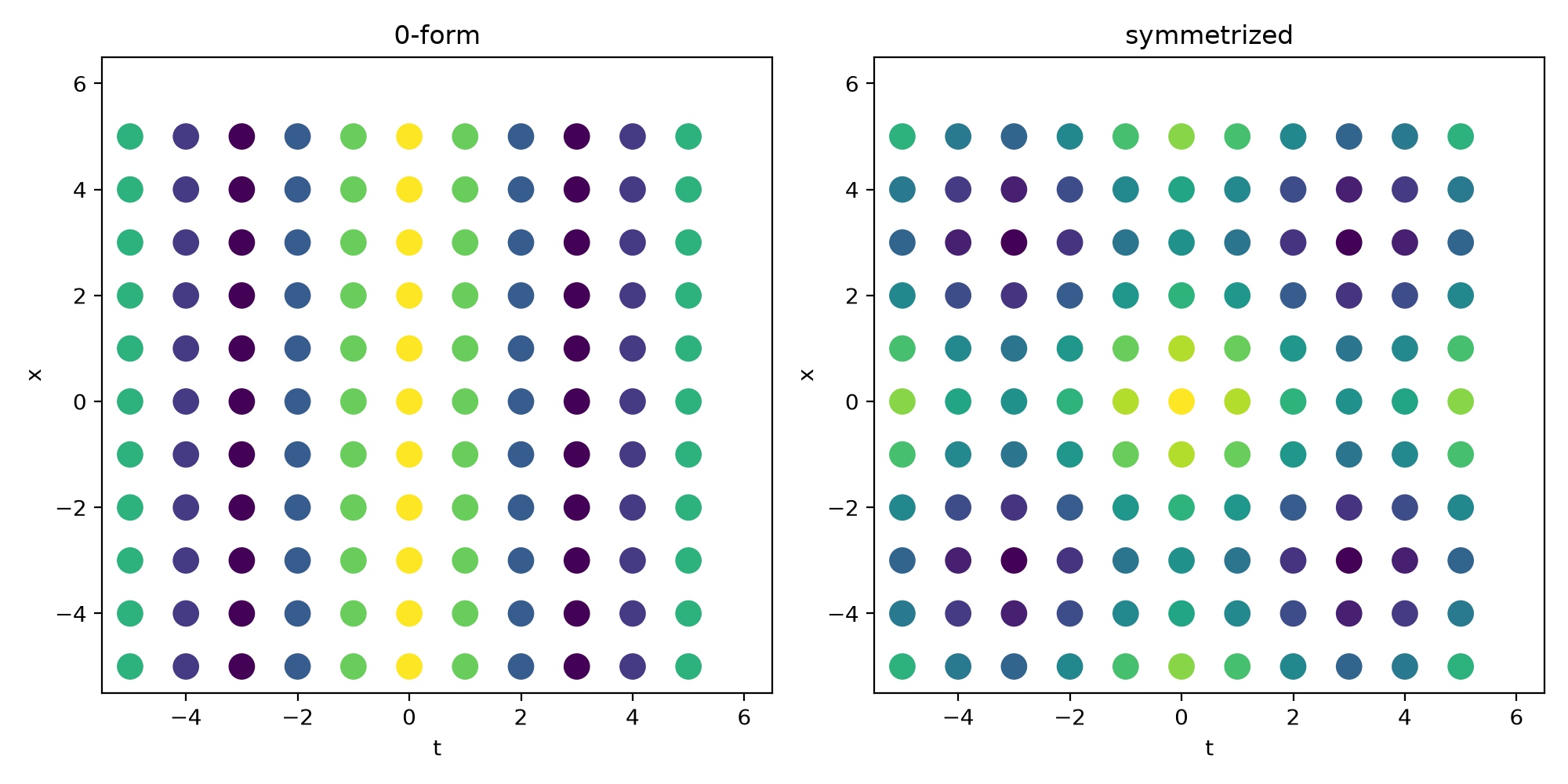
- symmetrize(correlator, dims=(-1,))[source]
Average
correlatorover the hyperoctahedral group (D!·2^D signed permutations).Projects onto the totally-symmetric (A₁/trivial) irrep of the lattice point group.
(
Source code,png,hires.png,pdf)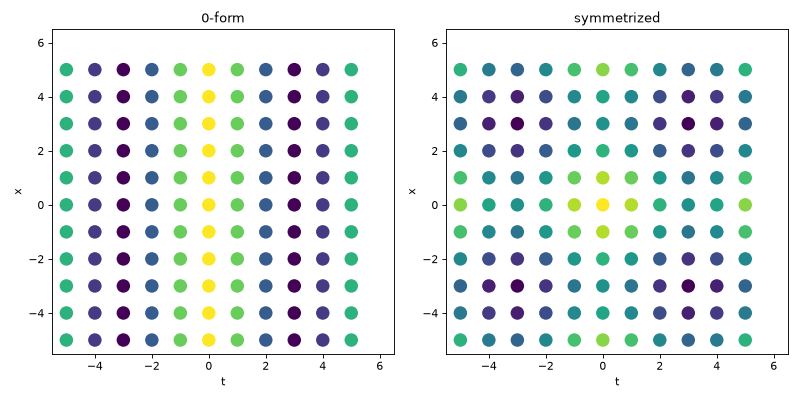
- Parameters
correlator (np.ndarray) – Spatial shape
(N,...,N)(or any array whosedimsaxes span the sites of this lattice after linearization).dims (tuple of int) – Axes to symmetrize (same convention as
linearize()).
- Returns
Same shape as
correlator.- Return type
np.ndarray
Two Dimensions
- class supervillain.lattice.Lattice2D(n)[source]
A two-dimensional square lattice — a thin wrapper around
LatticewithD=2.All lattice machinery (forms, exterior derivative, codifferential, Fourier transforms, symmetrize, linearize/coordinatize, …) is inherited from
Lattice.Lattice2Dadds only theplot_form()visualisation helper and thent/nxaliases.- Parameters
n (int) – The number of sites on a side.
- classmethod from_h5(group, strict=True, _top=True)[source]
Reconstruct from HDF5 by reading D and N reconstructing the rest.
- property plaquettes
\(C(2,2) N^2 = N^2\).
- Type
Number of plaquettes (2-cells)
- property nt
Temporal extent N.
- property nx
Spatial extent N.
- property t
FFT-convention t-coordinates (first direction), shape (N,).
- property x
FFT-convention x-coordinates (second direction), shape (N,).
- property T
Array of shape (N, N) with the t-coordinate at each site.
- property X
Array of shape (N, N) with the x-coordinate at each site.
- plot_form(form, axis, label=None, zorder=None, cmap=None, cbar_kw={}, norm=<matplotlib.colors.CenteredNorm object>, pointsize=200, linkwidth=0.025, background='white', markerstyle='o')[source]
Plots the form on the axis. The degree of the form determines whether sites, links, or plaquettes are visualized.
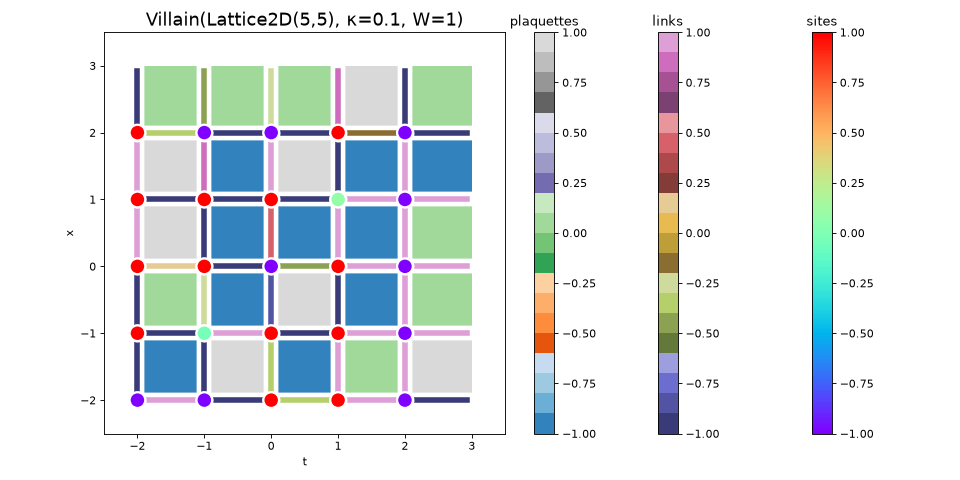
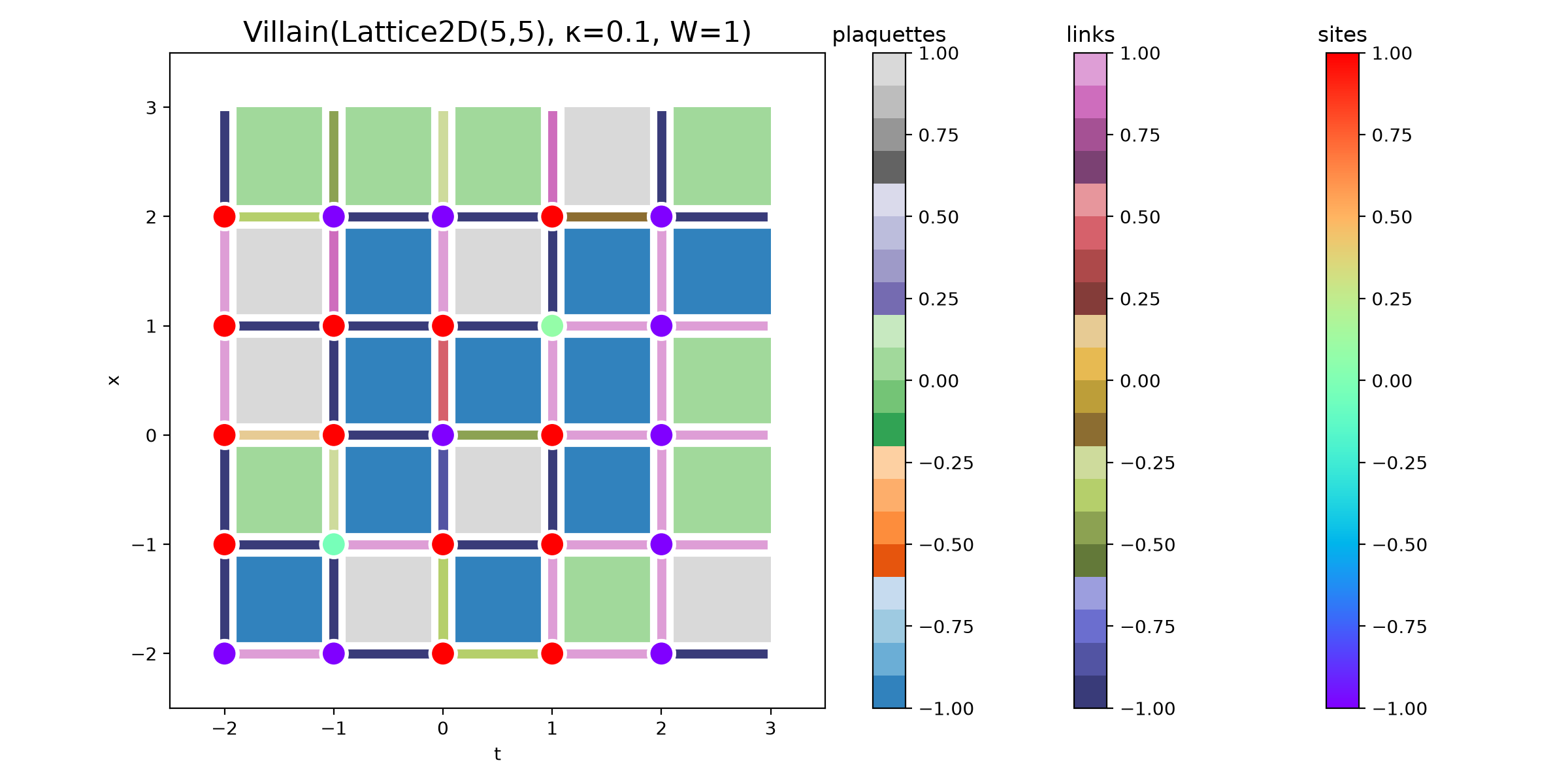
The following figure shows a 0-form plotted on sites, a 1-form on links, and a 2-form on plaquettes. See the source for details.
(
Source code,png,hires.png,pdf)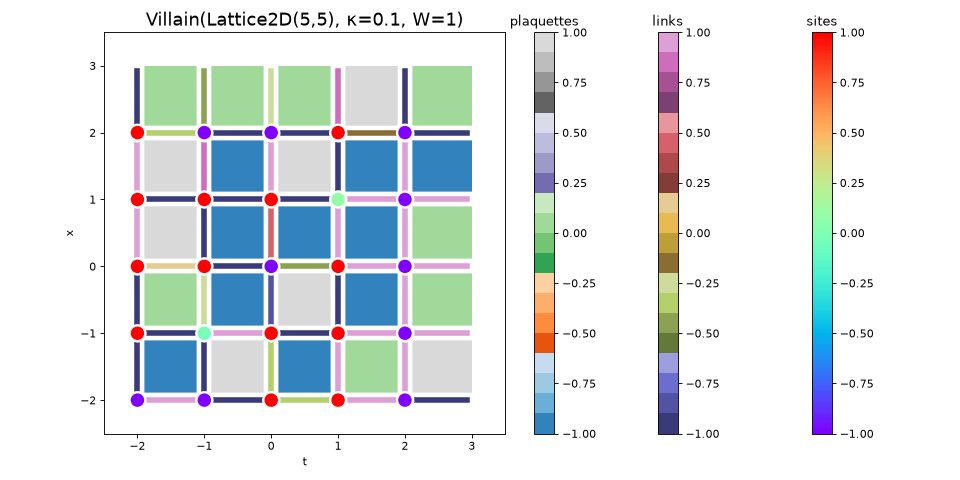
- Parameters
form (Form) – The p-form to plot;
form.degreedetermines the visualization.axis (matplotlib.pyplot.axis) – The axis on which to plot.
- Returns
A handle for the data-sensitive part of the plot.
- Return type
matplotlib.image.AxesImage
- Other Parameters
label (string) – If specified, show a colorbar with the title given by the label.
zorder (float) – If None defaults to
-form.degreeto layer plaquettes, links, and sites well.cmap (string or matplotlib.colors.Colormap) – If a string, it should name a colormap known to matplotlib.
cbar_kw (dict) – A dictionary of keyword arguments forwarded to the colorbar constructor.
norm (matplotlib.colors.Normalize) – A matplotlib color normalization.